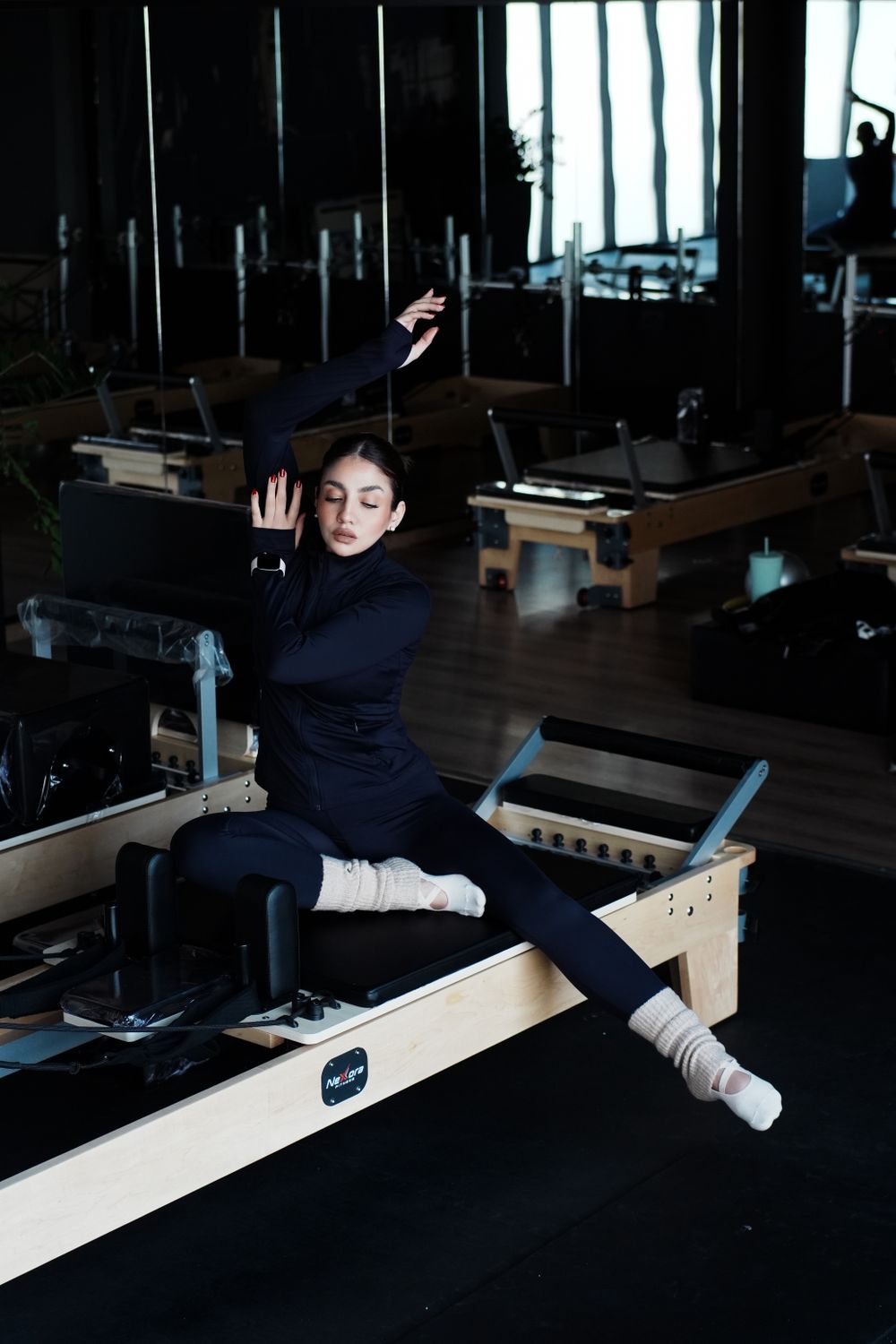
What to Know
When asking Gizem Köymen about Reformer Pilates, you may often hear control and tempo. These concepts cannot be summarised simply as moving slowly or returning the carriage quietly. Muscle roles, spring effects and the body’s support relationships can change through a movement. Understanding the language helps avoid automatically equating visible carriage direction with what happens in the body. This article explains terms such as eccentric, concentric and tempo rather than providing exercise durations or a repetition plan. Asking about the task’s purpose offers more information than copying a speed cue alone.
Changing tempo can change the time spent in one phase, but duration alone does not establish the total load or an individual’s working level. Resistance, movement range and the task also matter. Treating two examples as equivalent only because they take the same time hides their other mechanical characteristics.
What does eccentric work describe?
In simplified terms, eccentric work describes an active muscle producing force as it lengthens. Concentric work describes force production accompanied by muscle shortening. Isometric refers to force production without a clear overall change in muscle length. These terms describe how a particular muscle contributes to a task, rather than only the movement’s visible direction. Different muscles can take different roles at the same time. Reducing an entire exercise, or even a body region, to one term in every situation can therefore remove important details from the explanation.
Carriage return and muscle role are different
As a Reformer carriage moves towards its starting point, spring force may contribute in a particular direction. The participant may be controlling how that return occurs, but which muscle lengthens or shortens depends on body position and the task. Calling every return eccentric is therefore inaccurate. Moving away from the starting point also does not establish the same muscle role in every exercise. When a term is used in class, ask which region or phase it refers to. The movement path is not a complete map of muscle behaviour.
Tempo is more than total duration
The timing relationship between a movement’s start, travel, pause and return can vary. A tempo explanation may separate these phases through numbers or a spoken rhythm. It helps to clarify whether a count means seconds, beats or simply a cue for following the explanation. Two movements taking the same total time may feel different when that time is distributed differently. Holding a position is not identical to moving continuously at a slow pace. These distinctions help you understand an instruction, rather than apply one numerical pattern to everybody.
What can a change of direction reveal?
The point where carriage travel reverses can be useful for understanding the task’s flow. Slowing, pausing and beginning the next direction do not have to look identical in every exercise; how they are approached relates to the purpose. An abrupt-looking or fast reversal does not explain its own cause either. Springs, distance, body position and the guidance must be considered together. Instead of drawing an immediate conclusion about weakness or an individual problem, first ask what is intended. Technical observation needs context before it becomes a judgement about a visible movement.
Slower does not always mean more correct
A slower task may make certain details easier to notice, but this does not mean every class should use a single speed. Different tasks can involve different timing relationships. Changing speed, range or support can alter the experience. Treating slowness alone as a quality measure loses the connection with the purpose of the work. Moving faster does not automatically indicate a more advanced exercise either. Understanding why a pace was chosen and what attention is requested in each phase is more useful than ranking the rhythm seen from outside.
Questions for reflecting on a class
Ask how tempo cues are given, how return phases are explained and how to request clarification. Sharing your equipment experience helps relate technical terms to everyday language. After the session, look beyond how slowly or quickly you moved: could you understand the purpose of different phases and follow the guidance? Discussing those questions with Gizem Köymen places the experience in a wider context than its appearance alone. Knowledge of eccentric control and tempo provides language for asking informed questions, rather than a prescription to apply independently.